Independent dead-man check
If the machine, scheduler, worker, or job disappears, the expected CronRadar signal disappears with it.
Automation monitoring
CronRadar gives recurring work an independent completion signal. It watches the expected schedule and execution lifecycle so a silent stop becomes an incident, not a customer report.
Runnable setup
Use this path when no framework extension fits. The schedule is declared on the start signal; completion and failure are explicit. Replace the API key and backup command, then run it from cron.
#!/usr/bin/env bash
set -euo pipefail

KEY="nightly-backup"
BASE="https://cron.life/ping/$KEY/$CRONRADAR_API_KEY"

curl --fail --max-time 5 "$BASE/start?schedule=0%202%20*%20*%20*"
if ./backup.sh; then
  curl --fail --max-time 5 "$BASE/complete"
else
  curl --fail --max-time 5 "$BASE/fail?message=backup%20failed"
  exit 1
fi
Why another signal
If the machine, scheduler, worker, or job disappears, the expected CronRadar signal disappears with it.
CronRadar evaluates the next expected run against a bounded grace period instead of treating every job like a fixed uptime probe.
Send start, complete, fail, and a bounded failure message. Keep detailed logs in the system built for them.
Group recurring work by application while framework extensions keep declared schedules synchronized.
Route incidents to email, Slack, webhook, Discord, or PagerDuty on every plan.
Official SDKs cap HTTP requests at five seconds and catch monitoring failures so the job keeps its original behavior.
Real interface
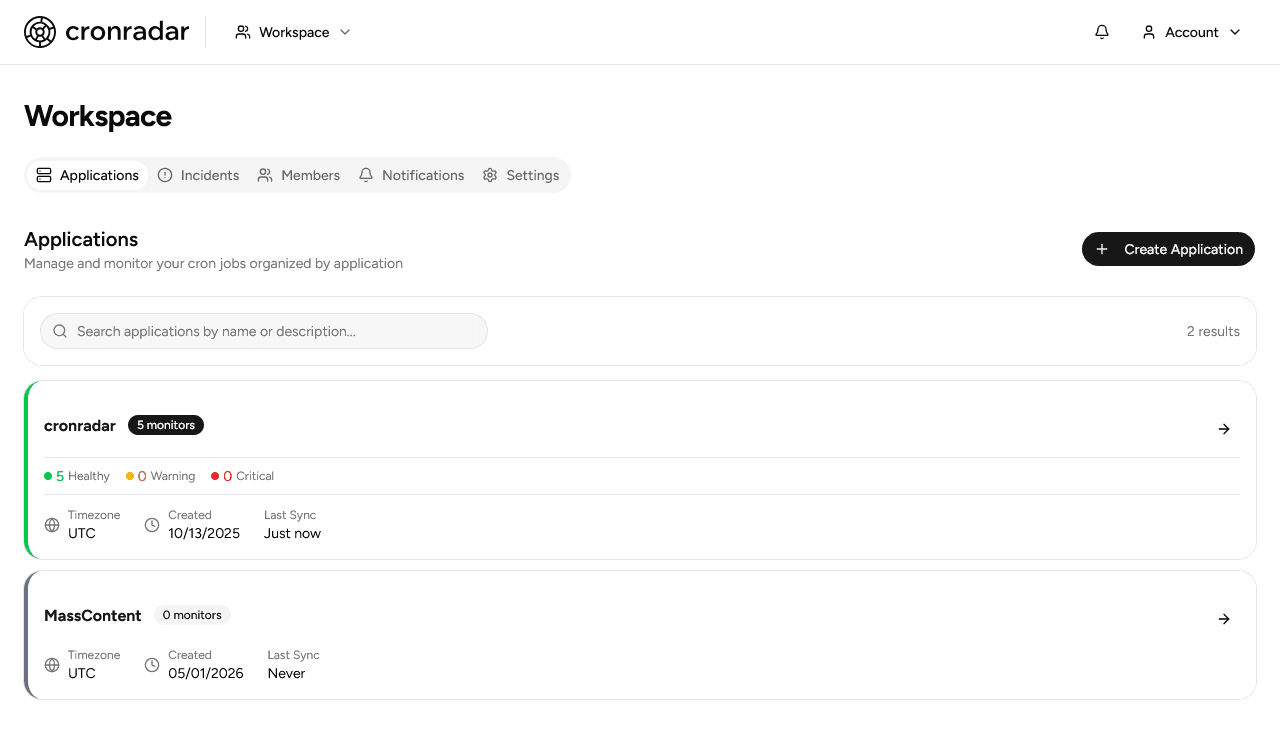
Migration
Choose a low-risk production automation. Use Hangfire or Quartz discovery, a base SDK wrapper, or the lifecycle URL above.
Observe a normal completion, then run a safe failure or missed-run drill and confirm the intended notification arrives.
Remove the matching legacy heartbeat only after the schedule, ownership, and alert destination are correct. Repeat job by job.
Questions
No. CronRadar receives signals from scheduled work; it does not probe websites or publish status pages.
No. Store diagnostic detail in your logging platform. CronRadar keeps execution events and an optional bounded failure message.
Yes. Define a bounded expectation such as records_processed >= 1, then report that numeric result with the completion event. Missing or failing checks create an explained outcome incident.
Use Hangfire or Quartz.NET discovery when available. Otherwise choose the base SDK for your language; raw HTTP is the smallest universal path.
See the complete workflow on the product overview.
Free protects five active production automations with unlimited collaborators and every supported alert channel.