Declare
A framework extension reads Hangfire, Quartz.NET, Celery, or Laravel schedules. Base SDKs and raw HTTP can declare other recurring work.
Product overview
CronRadar turns recurring jobs into a current inventory, watches their expected lifecycle, and tells the responsible team when a run is missed, failed, stuck, or disappears.
The product
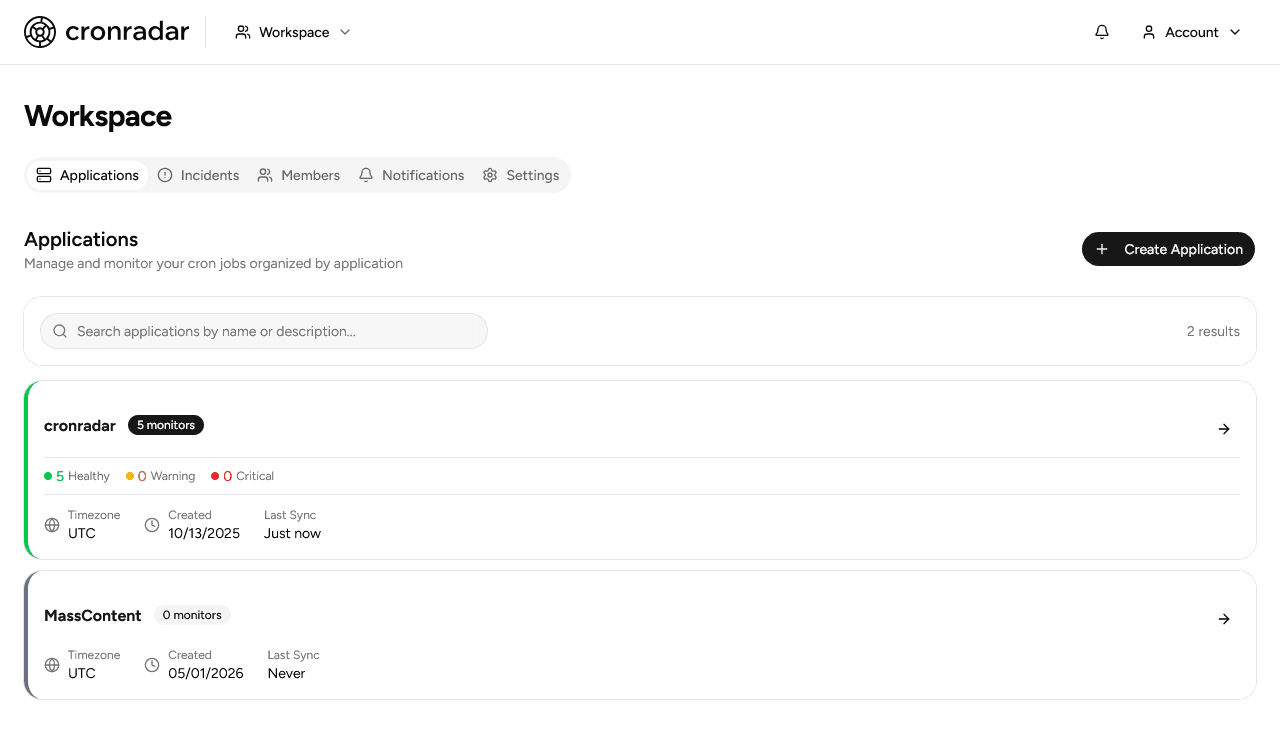
CronRadar shows the health of automated work by application. It does not replace the scheduler, logs, or on-call system you already use.
How it works
A framework extension reads Hangfire, Quartz.NET, Celery, or Laravel schedules. Base SDKs and raw HTTP can declare other recurring work.
Start, completion, failure, and expected schedule signals establish whether the latest run is healthy, late, failed, or timed out.
An incident is recorded and dispatched to the configured email, Slack, webhook, Discord, or PagerDuty destination.
Evidence, not promises
The monitoring worker checks expected schedules every 30 seconds. Alert delivery time is not guaranteed.
Constants.Monitoring.CheckIntervalSeconds
Official SDK HTTP calls are bounded and monitoring errors are caught.
Constants.Sdk.RequestTimeoutSeconds
Framework integrations synchronize declared jobs so the inventory can follow code and scheduler changes.
Detect missed, failed, stuck, disappeared, and completed runs that violate a bounded outcome expectation.
Email, Slack, webhook, Discord, and PagerDuty are included on every plan.
Ping history is retained for 30 days and alert history for 90 days.
30 days / 90 days
Choose your path
Reference path
Startup and periodic registry synchronization plus execution filtering.
Native .NET
Trigger discovery, schedule translation, and a scheduler-wide job listener.
Universal path
Wrap .NET, Node.js, Python, or PHP work, or report a complete lifecycle with curl.
Product boundaries
No. Hangfire, Quartz, cron, Celery, or Laravel still schedules and executes the work.
No. CronRadar records bounded lifecycle evidence and links the incident back to the team’s investigation tools.
No. Route to PagerDuty or another destination; CronRadar does not build escalation calendars.
No. The product is scoped to scheduled and recurring automation reliability.
Use the card-free Team trial, then stay on Free or explicitly choose a fixed paid plan.